Never before has a single threat simultaneously affected natural, economic, and health systems with such speed and scope.
Climate change now poses the greatest threat to global health in the 21st century, according to the World Health Organization (WHO). The average global temperature has already risen by more than 1.1°C above pre-industrial levels, with projections indicating a rise to 1.5°C by 2040 if greenhouse gas emissions are not drastically reduced.
This phenomenon is not merely environmental: it is profoundly social, economic, and health-related. Heat waves, droughts, floods, wildfires, ecosystem collapse, and the spread of disease vectors are some of the most visible manifestations of a planetary system under increasing stress.
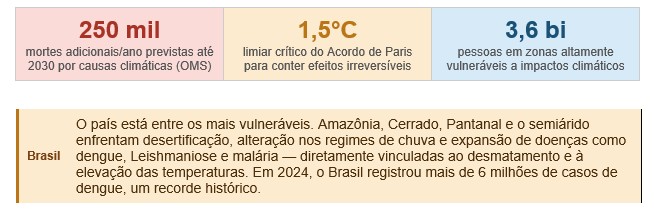
The One Health Concept
Human, animal, and environmental health are not separate domains—they are facets of the same living, interdependent, and fragile system.
The One Health approach recognizes that human health is intrinsically connected to the health of animals and ecosystems. This concept was formalized by international organizations such as the WHO, FAO, and OIE, and has gained increasing momentum following the COVID-19 pandemic, which laid bare how environmental degradation and human-animal interaction can trigger global health crises.
The three interconnected pillars
•Human Health:epidemiological surveillance, control of emerging diseases, food and nutritional security.
•Animal Health:control of zoonotic diseases, antimicrobial resistance, animal welfare, and wildlife monitoring.
•Environmental Health:ecosystem integrity, water quality, biodiversity, and climate regulation.

Why does One Health generate more effective solutions?
The One Health approach breaks down historical silos between human medicine, veterinary medicine, and environmental sciences. By integrating epidemiological surveillance, environmental monitoring, and animal health into unified early warning systems, it is possible to:
• Detect zoonotic outbreaks before they become pandemics.
• Reduce antibiotic use in livestock farming, combating antimicrobial resistance.
• Identify early environmental indicators of health risks.
• Develop integrated public policies that address health, the environment, and agriculture collectively.
Antimicrobial resistance, for example, kills about 1.3 million people a year and is directly linked to the indiscriminate use of antibiotics in agriculture and livestock. Only a One Health approach—one that combines veterinary regulation, agricultural practices, and public health policies—can address this challenge with the necessary effectiveness.
Climate Impacts on One Health
Climate change amplifies risks to One Health in multiple ways simultaneously:
• Geographic expansion of vectors: Aedes aegypti is spreading into regions that were previously cold. Dengue, Zika, and Chikungunya are reaching new populations with no prior immunity.
• Mental health: Eco-anxiety, ecological grief, post-disaster PTSD, and depression are growing phenomena, especially among indigenous, riverine, and youth populations.
• Food security: Elevated CO₂ reduces the nutritional value of staple crops such as rice and wheat. Droughts and heat compromise entire harvests.
• Water quality: Low water levels and aquifer contamination directly affect human and animal health as well as food production.
• New zoonoses: The melting of permafrost can release viruses and bacteria that have been extinct for millennia, against which humanity has no immune defenses.
Circular Bioeconomy: The Economy That Regenerates
The 20th-century economy was built on extraction, use, and disposal. The circular bioeconomy proposes a system where nothing is waste—everything returns to the cycle of life.
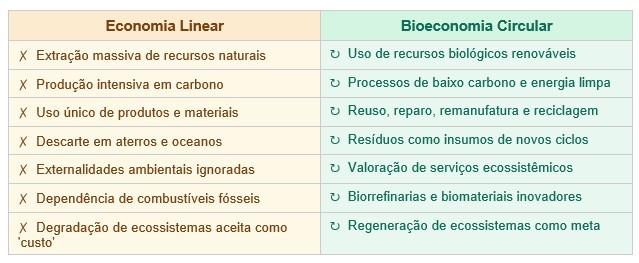
Linear Economy vs. Circular Bioeconomy
The linear economy follows the “extract → produce → discard” pattern, generating immense environmental liabilities: carbon emissions, soil and ocean pollution, deforestation, and the collapse of ecosystems. The circular bioeconomy breaks with this paradigm by integrating circular economy principles with the sustainable use of biological resources.
The Bioeconomy and Brazil
For Brazil, home to about 20% of the world’s biodiversity, the bioeconomy is not just an opportunity—it is a unique and historic comparative advantage. Standing forests are worth more than logged ones: socio-biodiversity products, biopharmaceuticals, ecotourism, payments for ecosystem services, and biotechnology are drivers of an economy that grows without destroying.
•Biopharmaceuticals:More than 50% of approved medications are derived from natural compounds. Preserved forests are living laboratories of therapeutic molecules still unknown to science.
•Bio-inputs:Replacing synthetic agrochemicals with bio-inputs reduces soil and water contamination, as well as human exposure to toxins—positively impacting the health of rural populations.
•Biorefineries:Bark, bagasse, and agroindustrial byproducts become feedstocks for bioenergy, bioplastics, and functional ingredients, closing the production cycle.
•Carbon and environmental services:Carbon markets compensate for forest preservation, creating economic incentives for conservation.

The ESG Agenda as a Driver of Systemic Change
ESG is not just corporate reporting—it is the language that translates the climate and health crises into the world of business, capital, and public policy.
The ESG (Environmental, Social, Governance) agenda represents the convergence of investor pressure, increasing regulation, and societal demand for corporations to internalize their environmental and social externalities. In the context of climate change and One Health, ESG provides the tools for measurement, governance, and financing to enable the sustainable transition to occur at scale.
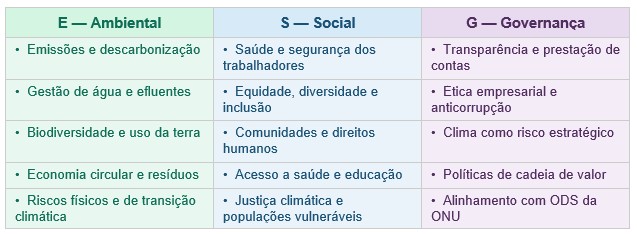
ESG and One Health: The Strategic Connection
The “E” pillar requires companies to map and reduce impacts on ecosystems—which is directly linked to pandemic prevention and the protection of public health. The 'S' pillar takes on a new dimension when we understand that the most vulnerable populations are the most exposed to environmental degradation and emerging diseases. And the 'G' governance pillar determines whether the commitments made are genuine or merely greenwashing.
Companies in agribusiness, mining, energy, and healthcare that genuinely embrace ESG must incorporate the One Health lens into their materiality analyses—assessing risks related to zoonoses, impacts on disease-regulating ecosystems, antimicrobial resistance, and food security as core business variables.
Frameworks and Regulatory Trends
•TCFD (Task Force on Climate-related Financial Disclosures):disclosure of physical and transition climate risks to investors.
•TNFD (Task Force on Nature-related Financial Disclosures):an extension of the TCFD to risks related to nature and biodiversity.
•CSRD (Corporate Sustainability Reporting Directive):Mandatory ESG reporting in Europe, applicable to companies operating within the bloc.
•ISS (International Sustainability Standards Board):global sustainability disclosure standards aligned with IFRS.
•Brazil:CMN Resolution 4,945 for the financial sector and growing market demand for integrated reports aligned with GRI and the UN SDGs.

How to Act Now to Curb Global Warming
The window of opportunity is open—but it is closing rapidly. Every tenth of a degree less in warming means fewer deaths, fewer pandemics, and fewer ecosystem collapses.
The IPCC is unequivocal: to limit warming to 1.5°C, global emissions must be reduced by 43% by 2030 compared to 2019 levels. We are behind schedule. But solutions exist—what is lacking is political will, well-allocated capital, and collective action across all sectors of society.
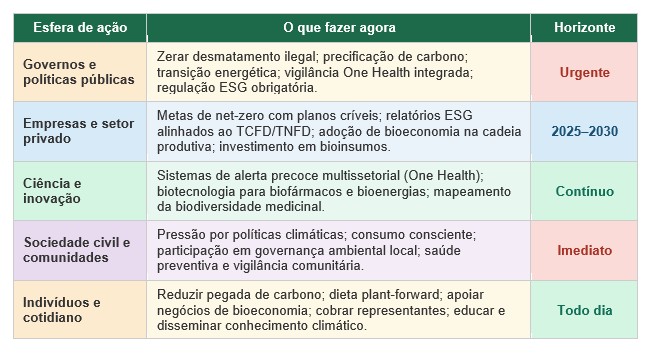
Priority Actions in the Context of One Health and the Bioeconomy
1. End deforestation and restore ecosystems
Forest protection and reforestation are the actions with the greatest simultaneous impact: they sequester carbon, preserve biodiversity, regulate the water cycle, reduce the risk of zoonotic diseases, and maintain ecosystem services essential to human health. The restoration of 1 billion hectares of degraded land could capture up to 205 gigatons of carbon, according to conservative estimates.
2. Accelerate the energy transition
Replacing fossil fuels with renewables (solar, wind, green hydrogen) is the most direct path to reducing CO₂ and methane emissions. In Brazil, the expansion of offshore wind and solar power and the production of Sustainable Aviation Fuel (SAF) from biomass are concrete opportunities for a circular bioeconomy that generates jobs and income.
3. Transforming agriculture and livestock farming
Agriculture and livestock farming account for about 25% of global emissions. The transition to agroecological systems, the use of bio-inputs, the integration of crops, livestock, and forests (iLPF), and the reduction of food waste are triple-impact strategies: they reduce emissions, protect health, and strengthen the bioeconomy.
4. Implement integrated One Health surveillance systems
Investing in national and global early-warning systems that integrate human, animal, and environmental health data is one of the most cost-effective measures available. The cost of preventing a pandemic is estimated to be between 500 and 1,000 times lower than the cost of responding to it.
5. Mobilize sustainable finance
Aligning financial flows with sustainability—through green bonds, climate taxonomies, carbon pricing, and divestment from fossil fuels—is a necessary condition for scaling up solutions. Brazil has a unique opportunity to lead a robust, high-integrity voluntary carbon market.

Summary: A Call for Integrated Action
Tackling climate change, protecting planetary health, and building a regenerative economy are not separate agendas—they are facets of the same historic imperative.
The One Health approach provides the conceptual framework for understanding that the next pandemic, the spread of dengue, the antimicrobial resistance crisis, and extreme weather events are symptoms of the same diagnosis: the breakdown of the relationship between humanity, animals, and ecosystems.
The circular bioeconomy points the way forward economically: it is possible to prosper while keeping ecosystems intact—and that integrity is, in itself, an investment in public health. And the ESG agenda provides the tools for measurement, governance, and financing to ensure this transition occurs at the corporate and market levels.
A country with Brazil’s biodiversity, territorial extent, and biotechnological potential has unique responsibilities and opportunities. Health policy, environmental policy, and economic policy must converge—and the One Health approach, anchored in a circular bioeconomy and guided by robust ESG metrics, is the most comprehensive roadmap available for this journey.
