Bispora is consolidating its position as a cutting-edge organization, guided by a purpose that transcends profit and is rooted in the creation of shared value. Our sustainability strategy is based on theB360 Model, a framework for systemic governance and operations, and on theB5.0 Biomembrane, the technological backbone that enables the transition to highly efficient industrial processes with low environmental impact.
Our vision is guided by the transdisciplinary paradigm ofOne Health. We understand that global systemic resilience depends on the inseparable integration of human health, animal health, and the integrity of ecosystems. From the perspective of a Senior ESG Consultant, Bispora not only mitigates linear risks in its value chain, but also enhances environmental compliance and biological regeneration, positioning itself as a strategic leader aligned with the UN 2030 Agenda’s Materiality Matrix.
Impact Mapping: Connecting the SDGs and Bispora Technologies
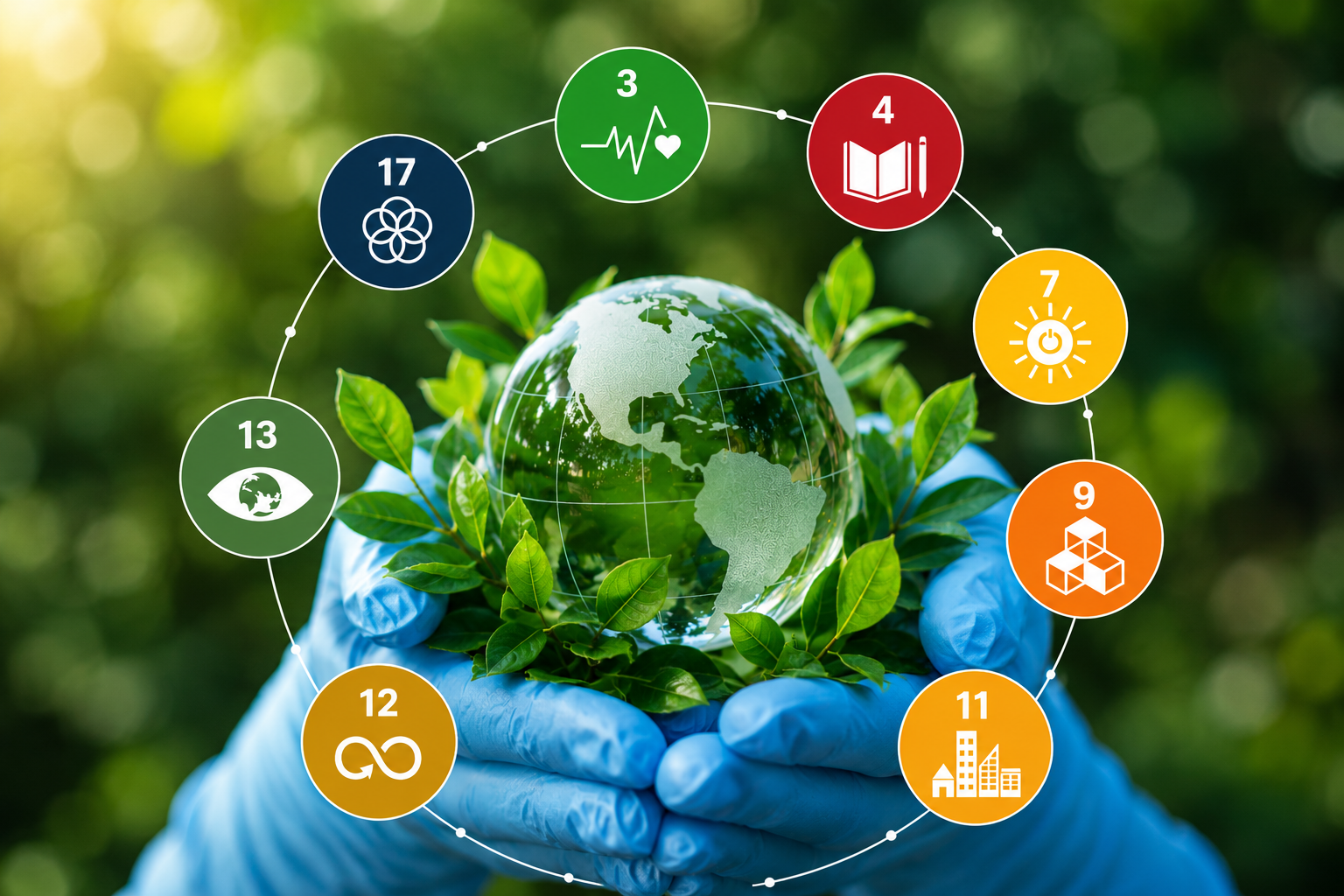
Below, we detail how Bispora’s technology portfolio translates global guidelines into assets with measurable impact, structured around our 8 priority Sustainable Development Goals (SDGs).
SDG 3: Good Health and Well-being
TheOne Healthapproach is implemented to ensure biological and nutritional safety.
ThePROTEIN 5Cplatform leverages the development of advanced biocomposites, strengthening food security and preventive health.
TheB5.0 Biomembraneestablishes high-performance biological containment barriers, ensuring controlled and safe environments for public and occupational health.
SDG 4: Quality Education
Bispora acts as a knowledge hub, democratizing cutting-edge science.
The platformsIBIVAandPROTEIN 5Cfunction as learning infrastructures, providing research data inopen-sourceand educational dashboards that train technicians and academics in the handling of complex biotechnological processes.
SDG 7: Affordable and Clean Energy
The focus is on drastically reducing industrial energy intensity through theB360 Model.
The application of theBiomembrane B5.0in filtration and separation processes optimizes industrial thermodynamics, requiring lower energy consumption per unit produced and eliminating energy-wasting bottlenecks in large-scale plants.
SDG 9: Industry, Innovation, and Infrastructure
TheD-PISTAplatform modernizes the manufacturing sector with data intelligence.
We promote the transition to Industry 5.0 by using theD-PISTAto manage smart infrastructures that support economic growth without compromising environmental integrity, fostering innovation in scalable biotechnology.
SDG 11: Sustainable Cities and Communities
Urban resilience is strengthened by the integration of theB360 Modeland theD-PISTAplatform.
Our solutions enable the monitoring and management of biological risks in dense urban environments, helping local governments design communities that are more resilient to health and environmental crises.
SDG 12: Responsible Consumption and Production
Circularity is the guiding principle of thePROTEIN 5Cplatform.
By integrating theBiomembrane B5.0, Bispora minimizes waste generation and negative externalities in mass production, closing the life cycle of materials and promoting the efficient use of finite natural resources.
SDG 13: Climate Action
We use theIBIVAplatform as a central tool for climate governance.
TheIBIVAplatform provides complete traceability of biological assets and real-time carbon metrics, enabling companies to monitor their environmental footprint and implement direct mitigation strategies against global warming.
SDG 17: Partnerships and Means of Implementation
The platformsIBIVA,PROTEIN 5C, andD-PISTAconstitute collaborative impact ecosystems.
We act as catalysts for multisectoral partnerships, bringing together academia, industry, and the public sector within a shared technical infrastructure to accelerate the implementation of the UN’s goals through shared innovation.
Technology Overview: Platforms as Catalysts for Impact
The following table summarizes the value proposition of our platforms in relation to our socio-environmental commitments.
Platform / Main Function / Priority SDGs Addressed
IBIVA
Biological traceability, carbon metrics monitoring, and data management for climate action. SDGs – 4, 13, 17
PROTEIN 5C
Development of high-performance nutritional solutions and promotion of the biotechnology circular economy. SDGs 3, 4, 12, 17
D-PISTA
Infrastructure intelligence, modernization of industrial parks, and promotion of urban and energy resilience. SDGs – 7, 9, 11, 17
The Future of Bispora and ESG Leadership
Bispora reaffirms its unwavering commitment to the 2030 Agenda, recognizing that sustainability is not a destination but an ongoing process of innovation and adaptation. The integration of theB360 Modeland our technology platforms not only shields the company from regulatory and environmental risks but also positions it at the forefront of global biotechnology.
By transforming global challenges into engineering and biological solutions, Bispora demonstrates that profitability and positive impact are synergistic drivers. We will continue to lead by example, proving that proprietary technology, when combined with ethical and visionary governance, is the most powerful tool for ensuring the prosperity of present and future generations.